

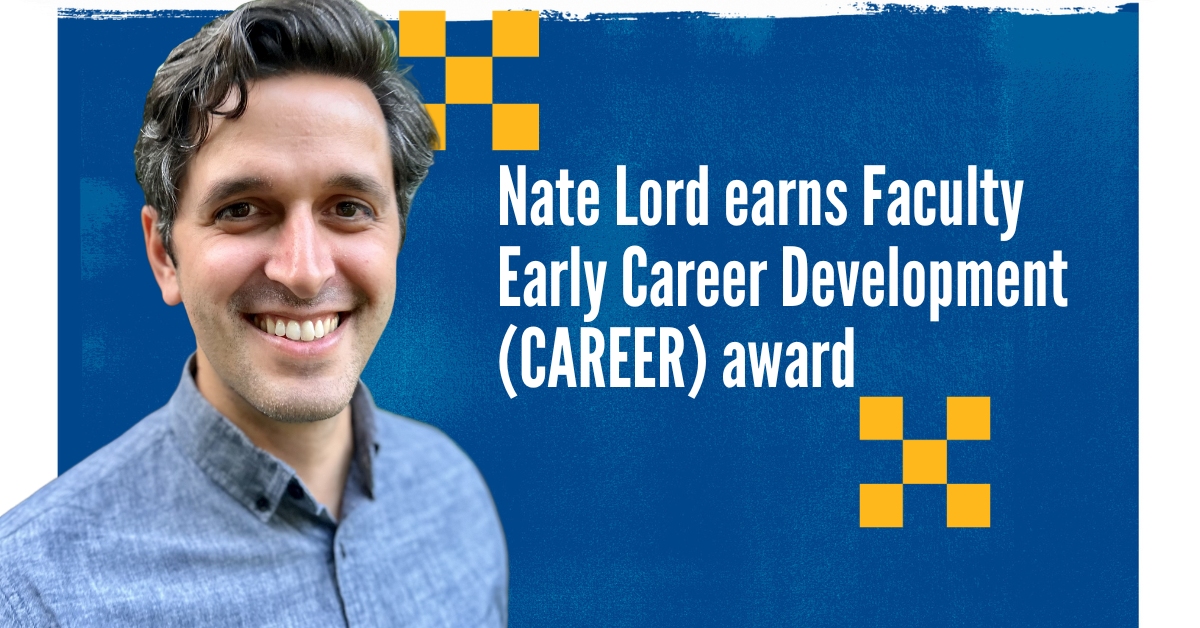
Assistant Professor Nate Lord has been awarded a grant from the National Science Foundation’s Faculty Early Career Development Program (CAREER). This five-year award will support Lord’s work in studying error correction and variability in zebrafish embryos.
“It’s nice to have a vote of confidence and a long-term investment by the National Science Foundation for this project,” said Lord.
The CAREER award supports early-career faculty who have the potential to serve as academic role models in research and education and to lead advances in the mission of their department.
Zebrafish embryos have been a longstanding interest for Lord, who earned his PhD in systems biology from Harvard University. While completing his postdoctoral training at Harvard, Lord began researching the development of zebrafish embryos. He realized there weren’t sufficient tools available at the time to analyze embryo variability.
“If we want to understand how variable embryos are, you can’t just look at a couple,” he said. “You have to look at the full range of behavior, and so that means you need to visualize hundreds or thousands of embryos, which is just not something that people do.”
To remedy this technical problem, Lord collaborated with Alan Watson at the Department of Cell Biology. They created a system of performing high-quality imaging of multiple embryos at a time.
This imaging system was the key Lord needed to address his research question of error correction and variability. With this project, he is interested in exploring what happens when embryos make mistakes and how the cells within the embryo correct these mistakes.
This award will empower Lord to hire additional lab members to further advance the imaging platform and focus on zebrafish research. It also opens avenues for future exploration in areas such as stem cell research.
“What’s so fascinating to me is that cells can collectively be very precise, even if individual cells are a little bit noisy and erratic,” Lord said. “If we can understand how that process happens, then I think we can learn from the embryos and be better at engineering replacement tissues out of stem cells.”