

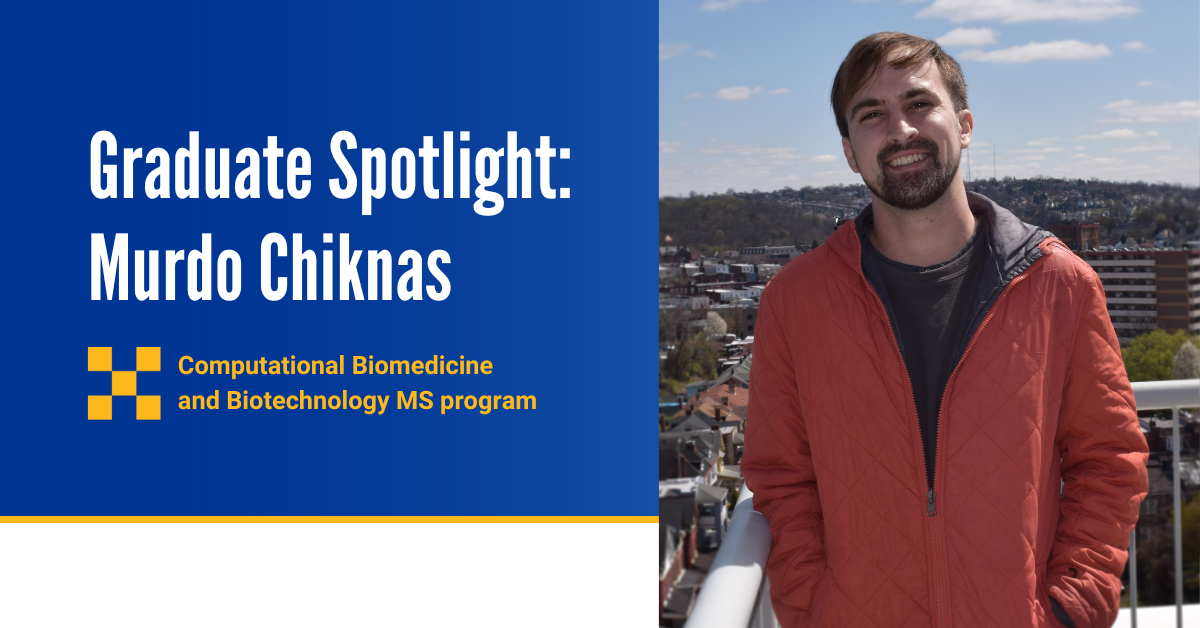
Peter Murdo Chiknas comes from a family of three generations of University of Pittsburgh graduates. His family legacy began in 1951, when his great aunt was the first person in his family to receive a degree. However, he didn’t envision himself in Pittsburgh until 2019, when he graduated from the University of Massachusetts, Amherst.
Boston was too expensive for a brand-new biochemistry graduate, and Chiknas wasn’t sure what his next step should be. His sister, a Pittsburgh native, suggested he move to Pittsburgh and explore the wealth of research opportunities the city has to offer. Chiknas landed a job in pulmonary medicine and gained valuable research experience throughout the COVID-19 pandemic. After a while working in the pulmonary medicine field, he realized he wanted to pursue a master’s degree to unify his interests.
That’s when a serendipitous encounter with Annie Kim, a doctoral candidate who attended the same primary school in Singapore as Chiknas, talked to him about the Department of Computational and Systems Biology.
This conversation inspired Chiknas to apply to the Computational Biomedicine and Biotechnology master’s degree program. “I wanted something that could allow me to thrive in different spaces,” he said. “I already had this background in biology and research, but I wanted something unifying like CoBB that would teach skills in programming and understanding data structures.”
Once he joined the CoBB program, Chiknas met a network of professors and students who helped him find his path. His classmates, who came from a variety of different fields ranging from biochemistry to data science, shared their interdisciplinary expertise.
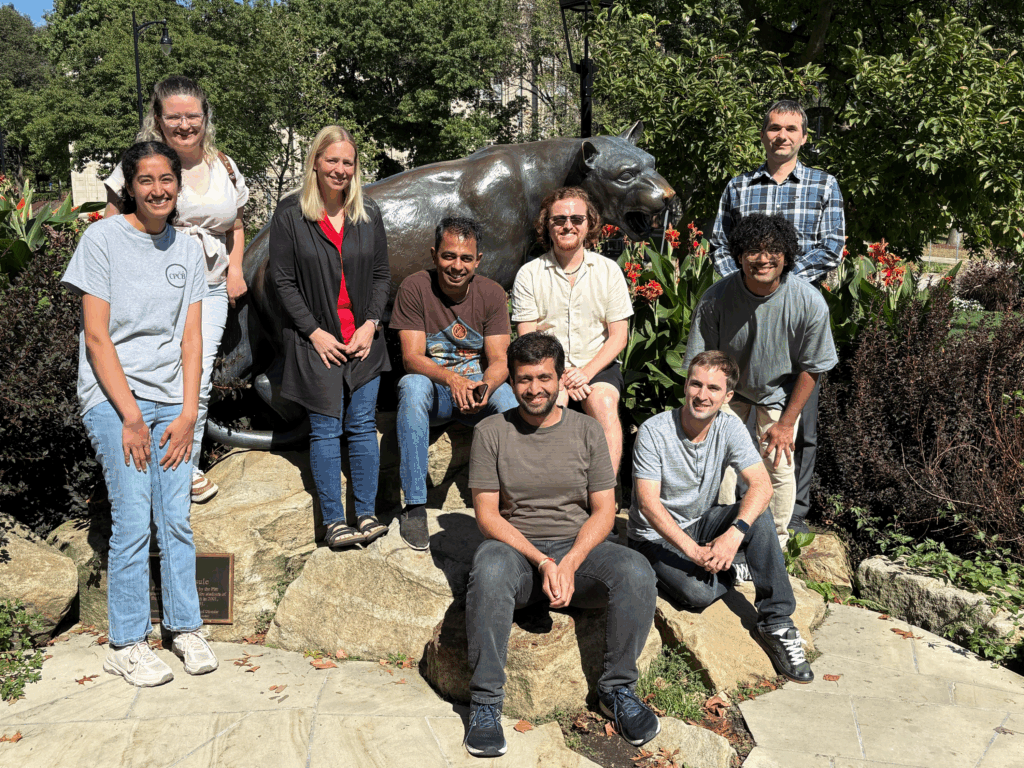
His mentor, Mert Gur, also connected him with courses that he thought would be of interest. Chiknas’s favorite class was Intro to Python, which exposed him to an array of things that can be accomplished with Python, from sequencing to uncovering genomic information. He says this class set him up with a solid foundation in programming that allowed him to thrive in the program.
“CoBB’s goal of creating someone who can step into both worlds seamlessly, both wet and dry lab, is a Herculean task,” Chiknas said. “But they do a great job of finding ways to show you what you know and don’t know in a way that makes you feel comfortable.”
While attending graduate school, Chiknas also had the opportunity to gain hands-on research experience in Associate Professor Robin Lee’s lab. He came into the lab with existing knowledge of microfluidics and mammalian cell culture. Lee helped Chiknas develop his skills in mathematical modeling and single-cell imaging while providing him with a welcoming laboratory he could call home while finishing his degree.
Funding cuts caused a change to Chiknas’s position, but he landed a new job as the lab manager in Shikhar Uttam’s lab. There, he stepped into the worlds of both wet and dry lab environments and continued to apply the skills he has learned in the CoBB program.
Now that Chiknas has crossed the graduation stage, his next steps are pursuing a PhD in systems biology or computational biology and advocating for science.

“I want to continuously learn new things,” Chiknas said. “My next plan is to be the first one in my family to get a PhD. It only took 90 years from the time my great aunt became the first person in my family to get a university degree, but we’ll get there.”
Chiknas leaves fellow CoBB students with one important piece of advice: “Use the fact that you’ve got a big network of people with so many diverse skills to help answer your questions. You will impress people by your willingness and ability to learn, not by what you already learned before you came here.”