

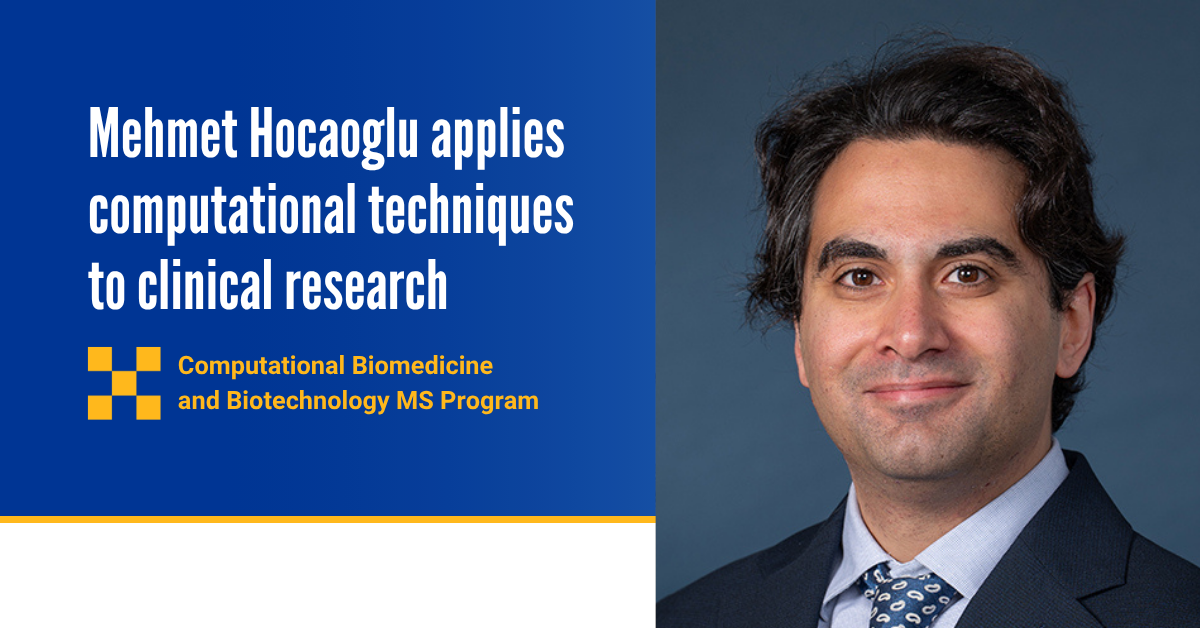
Mehmet Hocaoglu is a practicing rheumatologist and a student in the Computational Biomedicine and Biotechnology (CoBB) MS program. Coming from a clinical background, Hocaoglu was searching for a way to expand his skillset and learn computational biology techniques.
“As a physician, there are a lot of questions that we have in the clinic when we are taking care of patients, but we sometimes lack the skill sets to analyze the data and build a model to answer those questions,” Hocaoglu said.
The CoBB program offered Hocaoglu the opportunity to take classes to support his research interests in the clinic. Hocaoglu, who earned his Doctor of Medicine from Istanbul University, focuses on autoimmune diseases such as lupus and rheumatoid arthritis. His goal is to develop better risk prediction models for disease diagnosis, prognosis and prevention for autoimmunity using machine learning and AI.
He recently began a new position as an assistant professor at UMass Chan Medical School, where he conducts research, teaches medical students and treats patients.
One of his research initiatives involves using machine learning to build models that would give personalized risk assessment for lupus and rheumatoid arthritis. What’s unique about this project is the ability to provide a risk assessment even before the onset of symptoms.
Hocaoglu analyzes genetic information from biobanks, which are libraries that collect biological samples and health and lifestyle data from thousands of individuals for medical research. Using this information to build a risk assessment model, he can determine what medicine may work for a patient and provide them with an early prognosis.
Hocaoglu has been taking classes part time with CoBB while pursuing his career as an assistant professor and clinical researcher. This flexibility has allowed him to tailor his education to his professional interests. He entered the program with a foundation in coding and mathematics, so he was able to enroll directly in a machine learning class. The practical projects and hands-on training provided him with beneficial knowledge for his research.
Hocaoglu was initially hesitant about pursuing another degree while working full time, but he said he’s glad he decided to take the plunge and enroll.
“It might sound a little overwhelming for a clinical trainer to think about a master’s program in computational biology, but it is a very supportive environment,” Hocaoglu said. “I think people can benefit, especially if they are interested in research.”
His advice to other clinicians who may be interested in learning computational techniques is to register for a data analysis or computational biology class and see what new skills they will discover.